Membrane Separation Technology Revolutionizes Protein Powder Production: Breakthroughs in Efficiency, Purity, and Sustainability
In today's health-conscious world, protein powder is experiencing sustained market growth as a key nutritional supplement. Traditional production processes face challenges like low extraction efficiency, compromised nutrients, high energy consumption, and environmental pollution. Membrane separation technology, an efficient physical separation method, is fundamentally transforming protein powder manufacturing, offering businesses multiple advantages in purity, efficiency, and sustainability.
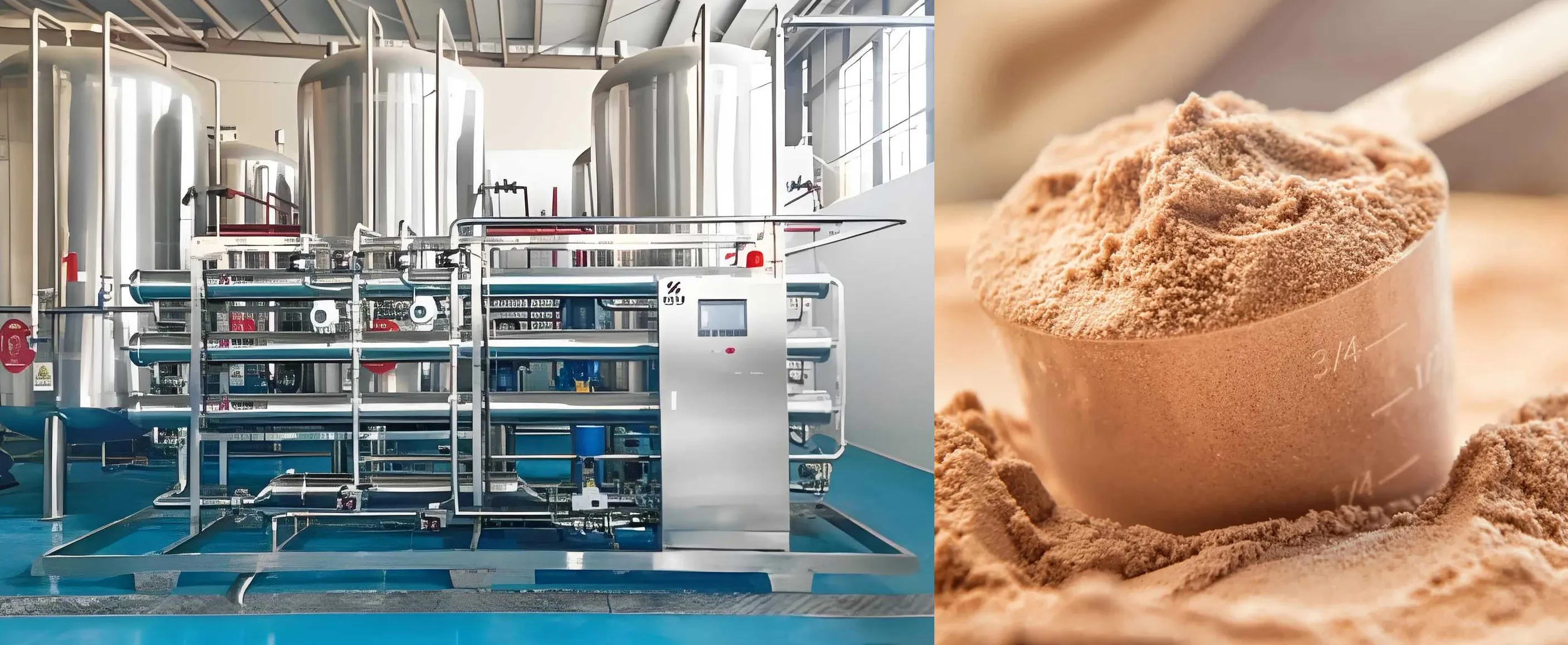
How Membrane Separation Technology Works and Its Types
Technical Basis
Membrane separation utilizes selectively permeable membranes to separate, purify, and concentrate multi-component mixtures under the influence of external energy or chemical potential differences. In protein powder production, this technology primarily separates proteins from other components efficiently based on differences in molecular size, shape, and charge.
Main Types of Membrane Separation in Protein Powder Production
Microfiltration (MF)
- Pore Size Range: 0.1-10 micrometers
- Primary Function: Removes fat globules, bacteria, and suspended particles
- Application Stage: Initial clarification of raw whey/soy protein
Ultrafiltration (UF)
- Pore Size Range: 0.001-0.1 micrometers
- Primary Function: Separates proteins from lactose, minerals, small peptides
- Application Stage: Core step for protein concentration and purification
Nanofiltration (NF)
- Pore Size Range: 0.001-0.01 micrometers
- Primary Function: Desalination, removal of monovalent ions
- Application Stage: Mineral adjustment and product refinement
Reverse Osmosis (RO)
- Pore Size Range: <0.001 micrometers
- Primary Function: Removes all solutes, including mono- and polyvalent ions
- Application Stage: Water recovery and material concentration
Specific Applications of Membrane Separation in Protein Powder Production
Optimizing Whey Protein Powder Production
Traditional whey protein production relies on acid/heat coagulation and centrifugal separation, with protein loss rates as high as 15-20%. Membrane separation technology changes this dynamic:
- Pretreatment Stage: Microfiltration effectively removes fat and microbes, improving raw material quality.
- Protein Concentration Stage: Ultrafiltration systems selectively separate whey proteins, preserving functional peptides.
- Refinement Stage: Nanofiltration adjusts mineral ratios, optimizing product flavor and solubility.
- Resource Recovery: Reverse osmosis treats permeate, recovering high-quality process water for recycling.
Actual production data shows that using membrane separation increases whey protein extraction rates from 75-80% with traditional methods to 92-95%, while product purity can exceed 90%.
Innovating Plant-Based Protein Powder Production
Membrane separation also excels in extracting pea, soy, and rice proteins:
- Gentle Extraction Conditions: Ambient temperature operation prevents protein denaturation, preserving natural structure and functional properties.
- Efficient Separation: Simultaneously achieves protein concentration, detoxification (e.g., phytic acid removal from pea protein), and deodorization.
- Component Customization: Allows precise control over protein content and amino acid composition based on market needs.
Production Advantages of Membrane Separation Equipment
Significant Product Quality Improvement
- High-Purity Protein: Protein content can reach 80-95%, far exceeding traditional methods.
- Superior Functional Properties: Low-temperature operation maintains natural protein conformation, improving solubility, gelation, and emulsification.
- Nutritional Integrity: Protects heat-sensitive amino acids and bioactive peptides, enhancing nutritional value.
- Low Allergenicity: Effectively removes potential allergens, meeting the needs of sensitive consumers.
Production Efficiency and Economic Benefits
- Increased Extraction Rate: Protein recovery improves by 15-25%.
- Reduced Energy Consumption: Energy use is 40-60% lower compared to traditional evaporation concentration.
- Continuous Production: Enables 24/7 operation, increasing equipment utilization.
- Reduced Chemical Use: Lowers consumption of acids, alkalis, and precipitants, reducing raw material costs.
Environmental Sustainability
- Wastewater Reduction: Water recovery rates of 70-90% significantly reduce wastewater discharge.
- Byproduct Utilization: Lactose and small peptides in the permeate can be recovered and reused, improving resource efficiency.
- Lower Carbon Footprint: Low-energy processes reduce greenhouse gas emissions.
- Cleaner Production: Reduced chemical additives lessen environmental burden.
Key Considerations for Membrane Separation Equipment Selection and System Design
Membrane Material Selection
- Polymer Membranes: Materials like Polyethersulfone (PES), Polyacrylonitrile (PAN) offer lower cost, suitable for most applications.
- Ceramic Membranes: High temperature and corrosion resistance, long lifespan, ideal for high-value products.
- Composite Membranes: Combine material advantages to optimize separation performance.
System Configuration Considerations
- Cross-Flow Filtration Design: Reduces membrane fouling, extends operation cycles.
- Modular Layout: Facilitates maintenance, cleaning, and capacity expansion.
- Automated Control: Integrated PLC/DCS systems for real-time monitoring of pressure, flow, and separation efficiency.
- CIP/SIP Systems: Ensure hygiene standards, meeting food-grade production requirements.
Industry Challenges and Solutions
Membrane Fouling and Cleaning
Membrane fouling is a primary operational challenge, mitigated by:
- Optimized Pretreatment: Microfiltration pretreatment removes colloids and suspended solids.
- Operating Parameter Control: Optimizing transmembrane pressure, temperature, and flow velocity.
- Regular Cleaning Protocols: Combining physical flushing and chemical cleaning to restore membrane flux.
- Novel Anti-Fouling Membranes: Developing hydrophilic-modified and surface-functionalized membrane materials.
Balancing Investment and Return
While initial investment in membrane separation equipment is relatively high, rapid ROI is achieved through:
- Increased product value (premium for high-purity protein)
- Lower operational costs (energy, water, wastewater treatment)
- Higher production efficiency and capacity utilization
- Obtaining sustainable production certifications, enhancing brand value
Future Development Trends
Technological Innovation Directions
- Smart Membrane Systems: Integrated sensors and AI algorithms for adaptive control and predictive maintenance.
- Novel Membrane Materials: Biomimetic and mixed-matrix membranes to improve selectivity and flux.
- Integrated Processes: Combining membrane separation with chromatography, electrodialysis, etc., for precise separation.
- Modular Design: Scalable, reconfigurable membrane systems to adapt to diverse production needs.
Market Application Expansion
- Personalized Nutrition: Customized specialty protein powders with specific amino acid profiles.
- Functional Peptides: Isolating bioactive peptides with specific physiological activities.
- Full Industry Chain Application: Complete closed-loop systems from raw material processing to wastewater reuse.
Conclusion
Membrane separation technology is redefining the standards for protein powder production, bringing unprecedented purity, efficiency, and sustainability to the industry. For protein powder manufacturers, investing in membrane separation equipment is not just a technological upgrade but a strategic move to meet market demand for high-quality, clean-label, and sustainable products. As the technology advances and costs continue to optimize, membrane separation is poised to become the standard for protein powder production, driving the entire industry toward greater efficiency, environmental friendliness, and higher value.
Ready to Upgrade Your Protein Powder Production?
Evaluate how membrane separation technology can optimize your process today. Our expert team can provide process assessments, equipment selection guidance, and ROI analysis. To get a customized solution, contact a professional membrane separation technology supplier through industry channels and take the first step toward revolutionizing your protein powder production.