Membrane Separation Technology for Ginsenoside Extraction: Processes, Advantages and Industrial Practice
Ginsenosides, as the core bioactive components in Panax ginseng (Araliaceae plants), are triterpenoid glycosides with diverse pharmacological effects, including immune enhancement, anti-fatigue, anti-inflammatory, and neuroprotective properties. With the booming global nutraceutical and pharmaceutical industries, the demand for high-purity ginsenosides is growing rapidly, driving the upgrading of extraction and purification technologies. Traditional ginsenoside extraction methods, such as solvent reflux, alcohol precipitation, and centrifugation, are plagued by problems like low extraction efficiency, serious loss of heat-sensitive ginsenoside monomers, high solvent residue, and heavy environmental pollution, which are difficult to meet the quality standards of high-end products. Membrane separation technology, relying on its advantages of precise molecular sieving, low-temperature operation, and green efficiency, has become the mainstream technology for ginsenoside extraction and purification, attracting extensive attention from industry and academia.
Key Characteristics of Ginsenosides and Challenges in Extraction
Ginsenosides are a class of steroidal compounds, mainly divided into protopanaxadiol (PPD) type, protopanaxatriol (PPT) type, and oleanolic acid type, with more than 40 monomers isolated from ginseng roots. Most ginsenosides are white amorphous powders or colorless crystals, soluble in water, methanol, and ethanol, slightly soluble in n-butanol, and insoluble in lipophilic organic solvents such as ether and benzene. Their molecular weights range from 700 to 1300Da, and they are highly heat-sensitive—high temperatures above 60℃ easily cause hydrolysis and structural damage, reducing their biological activity. These characteristics pose key challenges to extraction technologies: ensuring high extraction yield while retaining the activity of ginsenoside monomers, and achieving efficient separation from impurities such as proteins, polysaccharides, and tannins in ginseng extracts.
Membrane Separation Processes for Ginsenoside Extraction
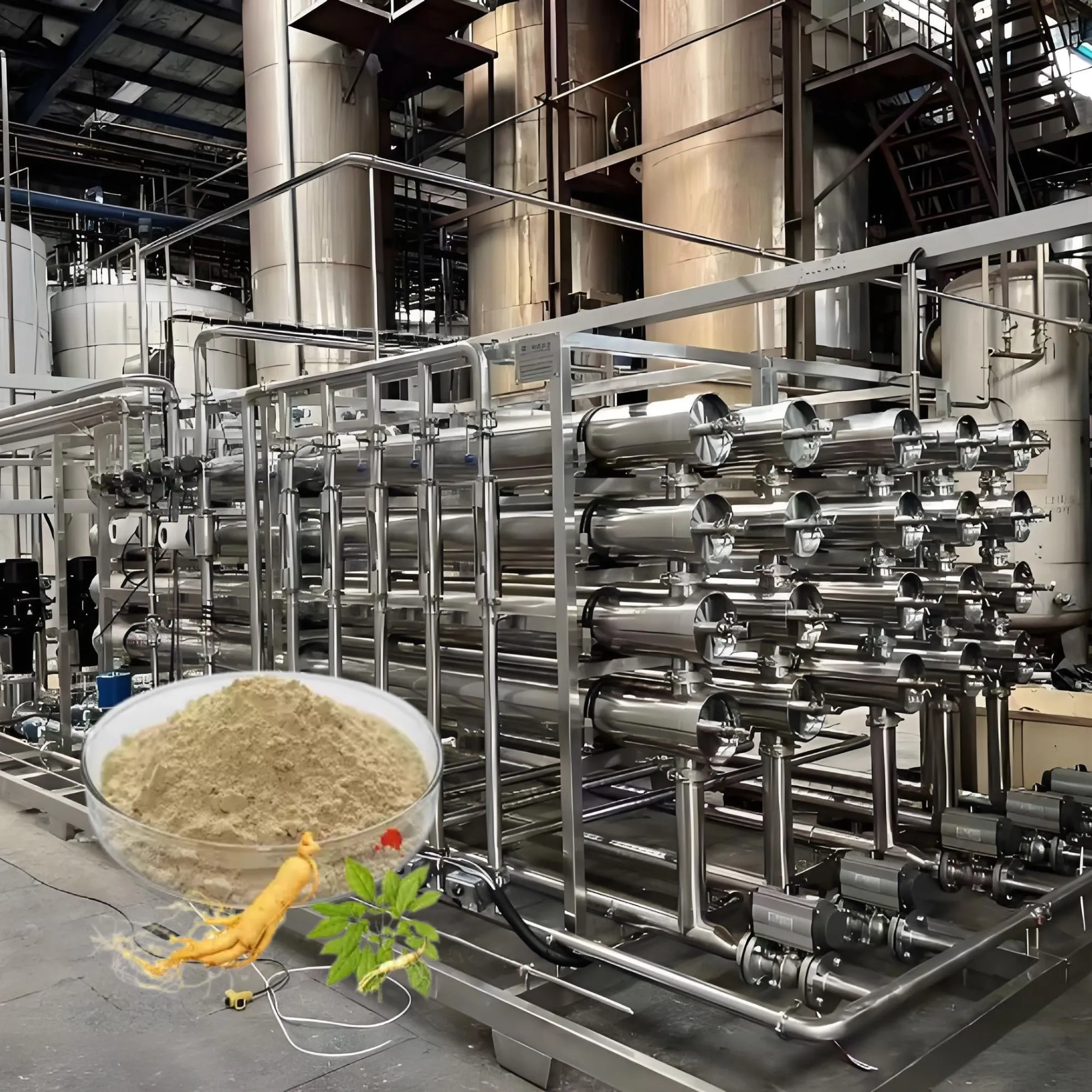
Ginsenoside extraction using membrane separation technology usually adopts a multi-stage combined process, matching different membrane types according to the molecular weight differences between ginsenosides and impurities, realizing sequential impurity removal, purification, and concentration. The core membrane technologies involved include microfiltration, ultrafiltration, nanofiltration, and ceramic membrane separation, each playing a unique role in the process chain.
1. Microfiltration (MF): Pretreatment for Impurity Removal
Microfiltration is the first step in ginsenoside extraction, mainly used for the pretreatment of crude ginseng extracts. Selecting microfiltration membranes with a pore size of 0.22-1.0μm can efficiently remove suspended particles, plant fibers, microorganisms, and large-particle colloids in the crude extract. This step not only improves the clarity of the extract but also reduces the pollution of subsequent membrane modules, avoiding membrane clogging caused by large impurities and extending the service life of membrane equipment. Compared with traditional plate-frame filtration, microfiltration can increase the light transmittance of ginseng crude extract to more than 92%, laying a solid foundation for the subsequent purification of ginsenosides.
2. Ultrafiltration (UF): Removal of Macromolecular Impurities
Ultrafiltration is the core purification step for ginsenosides, focusing on removing macromolecular impurities that are difficult to separate by traditional methods. According to the molecular weight range of ginsenosides (700-1300Da), ultrafiltration membranes with a molecular weight cut-off (MWCO) of 10-50kDa are preferred. These membranes can precisely retain macromolecular impurities such as proteins, pectin, and ginseng polysaccharides, while allowing small-molecule ginsenoside monomers (such as Rg1, Rb1, and Re) to pass through smoothly. Studies have shown that ultrafiltration treatment can reduce the content of macromolecular impurities in ginseng extract by more than 90%, and the recovery rate of ginsenosides reaches 95% or more. In addition, ultrafiltration can be operated at room temperature (25-35℃), avoiding the degradation of heat-sensitive ginsenosides caused by high-temperature treatment.
3. Nanofiltration (NF): Purification and Concentration of Ginsenosides
Nanofiltration is the key step to realize the enrichment and deep purification of ginsenosides, which is the core of improving the purity of ginsenosides. Selecting nanofiltration membranes with a MWCO of 300-1000Da can directionally retain ginsenoside monomers, while removing small-molecule impurities such as inorganic salts, small-molecule sugars, and residual solvents. At the same time, nanofiltration has a concentration function, which can concentrate the ginsenoside solution to a solid content of 25-30% under low pressure (5-10bar), reducing the energy consumption of subsequent drying processes. Practice has proved that after nanofiltration treatment, the purity of total ginsenosides can be increased from 20-30% (after ultrafiltration) to more than 95%, and the concentration multiple of ginsenosides can reach 6-8 times. For the separation of structurally similar ginsenoside monomers, modified nanofiltration membranes (such as graphene oxide composite membranes) can be used to enhance separation selectivity through electrostatic interaction and hydrophilicity regulation.
4. Ceramic Membrane: Adaptation to Harsh Extraction Conditions
Ceramic membranes are widely used in large-scale industrial production of ginsenosides due to their high temperature resistance, acid and alkali resistance, and organic solvent resistance. In the extraction process of ginsenosides, ethanol is often used as an extraction solvent, and traditional organic membranes are easily swollen and damaged by ethanol, while ceramic membranes can withstand the erosion of high-concentration ethanol (up to 95%) and have a service life of 3-5 years. Ceramic membranes can be used in both pretreatment and deep purification steps; for example, ceramic microfiltration membranes can handle high-viscosity ginseng crude extracts, and ceramic ultrafiltration membranes can further improve the purification efficiency of ginsenosides, adapting to the large-scale continuous production needs of ginsenoside extraction.
Core Advantages of Membrane Separation Technology in Ginsenoside Extraction
Compared with traditional extraction and purification technologies, membrane separation technology has obvious advantages in ginsenoside extraction, especially in retaining bioactivity, improving product purity, and reducing production costs, which fully meets the requirements of green production and high-end product development.
- Low-Temperature Operation to Retain Bioactivity: The entire membrane separation process is carried out at 25-45℃, which avoids the hydrolysis and degradation of heat-sensitive ginsenoside monomers caused by high temperatures. The retention rate of ginsenoside active components is as high as 98%, and the bioavailability is increased by 40% compared with traditional thermal concentration processes.
- Precise Separation to Improve Purity: Through the precise screening of membranes with different pore sizes and MWCO, the separation of ginsenosides from impurities is more targeted. The purity of total ginsenosides can reach more than 95%, and the content of key monomers (such as Rg1 and Rb1) can be effectively enriched, meeting the quality standards of pharmaceutical-grade ginsenosides.
- Green and Efficient to Reduce Environmental Pressure: Membrane separation is a physical separation process without adding chemical reagents, which eliminates solvent residue and chemical pollution. The ethanol recovery rate in the extraction process is increased to more than 85%, reducing solvent consumption by 70% compared with traditional alcohol precipitation processes, and the wastewater reuse rate is ≥80%, which is in line with the global dual-carbon goal.
- Energy Saving and Cost Reduction to Enhance Competitiveness: The energy consumption of membrane separation is only 10-20% of that of traditional thermal concentration processes, and the tonnage treatment cost of ginsenoside extraction is reduced by 50%. At the same time, the modular design of membrane equipment can realize flexible expansion from laboratory pilot tests to industrial mass production (processing capacity: 50L/h-50 tons/hour), reducing the initial investment cost of enterprises.
Challenges and Targeted Solutions in Industrial Application
Although membrane separation technology has significant advantages in ginsenoside extraction, it still faces some challenges in large-scale industrial application, mainly focusing on membrane fouling, membrane material adaptability, and separation selectivity of similar monomers. The industry has formed targeted solutions to promote the stable application of the technology.
1. Core Challenges
Membrane fouling is the most prominent problem: the colloids, proteins, and polysaccharides in ginseng extracts are easily adsorbed on the membrane surface to form a cake layer, which reduces membrane flux and affects separation efficiency. Secondly, the separation selectivity of traditional membranes for structurally similar ginsenoside monomers (such as Rg1 and Re) is insufficient, making it difficult to obtain high-purity single monomers. In addition, the high cost of imported special membrane materials increases the production pressure of small and medium-sized enterprises.
2. Targeted Solutions
For membrane fouling, a combination of "pretreatment optimization + online cleaning" can be adopted: optimizing the microfiltration pretreatment process to reduce the content of fouling substances; adopting cross-flow filtration mode to reduce the accumulation of impurities on the membrane surface; and regularly using low-pH citric acid solution or high-pH sodium hydroxide solution for chemical cleaning to restore membrane flux. For the separation of similar monomers, modified membrane materials (such as graphene oxide membranes) can be used to regulate the separation mechanism through oxidation degree adjustment, improving the separation factor of similar ginsenoside monomers. For cost issues, domestic modified membrane materials have gradually matured, with performance close to international advanced levels, which can replace imported products and reduce equipment investment costs by 30-40%.
Industry Outlook of Membrane Separation Technology in Ginsenoside Extraction
With the continuous expansion of the ginsenoside application market (including pharmaceuticals, health products, cosmetics, etc.), the demand for high-purity, low-residue ginsenosides will continue to grow, and membrane separation technology will develop towards intelligence, customization, and integration. In the future, the development of new functional membrane materials (such as nanocomposite membranes and graphene oxide membranes) will further improve the separation selectivity and membrane life, realizing the efficient separation of ginsenoside monomers. The integrated application of membrane separation technology with supercritical CO2 extraction will combine the advantages of both, achieving more efficient and green extraction of ginsenosides.
In addition, with the popularization of intelligent control technology, membrane separation equipment will realize real-time monitoring of membrane flux, pressure, and temperature, and automatic adjustment of process parameters, improving production stability and reducing labor costs. It is estimated that by 2027, the application rate of membrane separation technology in the global ginsenoside extraction industry will exceed 80%, and the market scale of related membrane equipment will exceed 3 billion yuan, becoming the core support for the high-value development of the ginseng deep processing industry.
Conclusion
Membrane separation technology, with its unique advantages of low-temperature lock-in, precise purification, green efficiency, and energy saving, has solved the key pain points of traditional ginsenoside extraction technologies, such as low purity, serious active component loss, and high environmental pollution. From laboratory pilot tests to large-scale industrial production, membrane separation technology has been continuously optimized and improved, becoming an indispensable core technology in the ginsenoside deep processing industry. With the innovation of membrane materials and the upgrading of process technology, membrane separation technology will further unlock the potential of ginsenoside resources, promote the upgrading of the global ginseng processing industry, and provide high-quality ginsenoside products for the health industry.