Membrane Separation Equipment in Date Syrup Production Process
1. Introduction
Date syrup (also called date molasses) is a popular natural sweetener rich in fructose, glucose, minerals and dietary fiber. With growing demand for clean‑label, healthy and natural food products, date syrup has been widely used in beverages, bakery, confectionery, dietary supplements and traditional food.
Traditional date syrup production relies on plate filtration, diatomite filtration, high‑temperature thermal concentration and chemical clarification. These methods often cause problems such as dark color, burnt flavor, unstable clarity, secondary precipitation, high energy consumption and short shelf life.
Membrane separation equipment provides a physical, low‑temperature and high‑efficiency solution. As a pressure‑driven molecular separation technology, membrane filtration achieves precise purification and concentration without phase change or chemical additives. It has become the core upgrading technology for modern date syrup manufacturing.This article explains the full application of membrane separation in date syrup production, including process flow, equipment selection, technical parameters and industrial advantages, fully compliant with Google SEO 2026 EEAT and user experience standards.
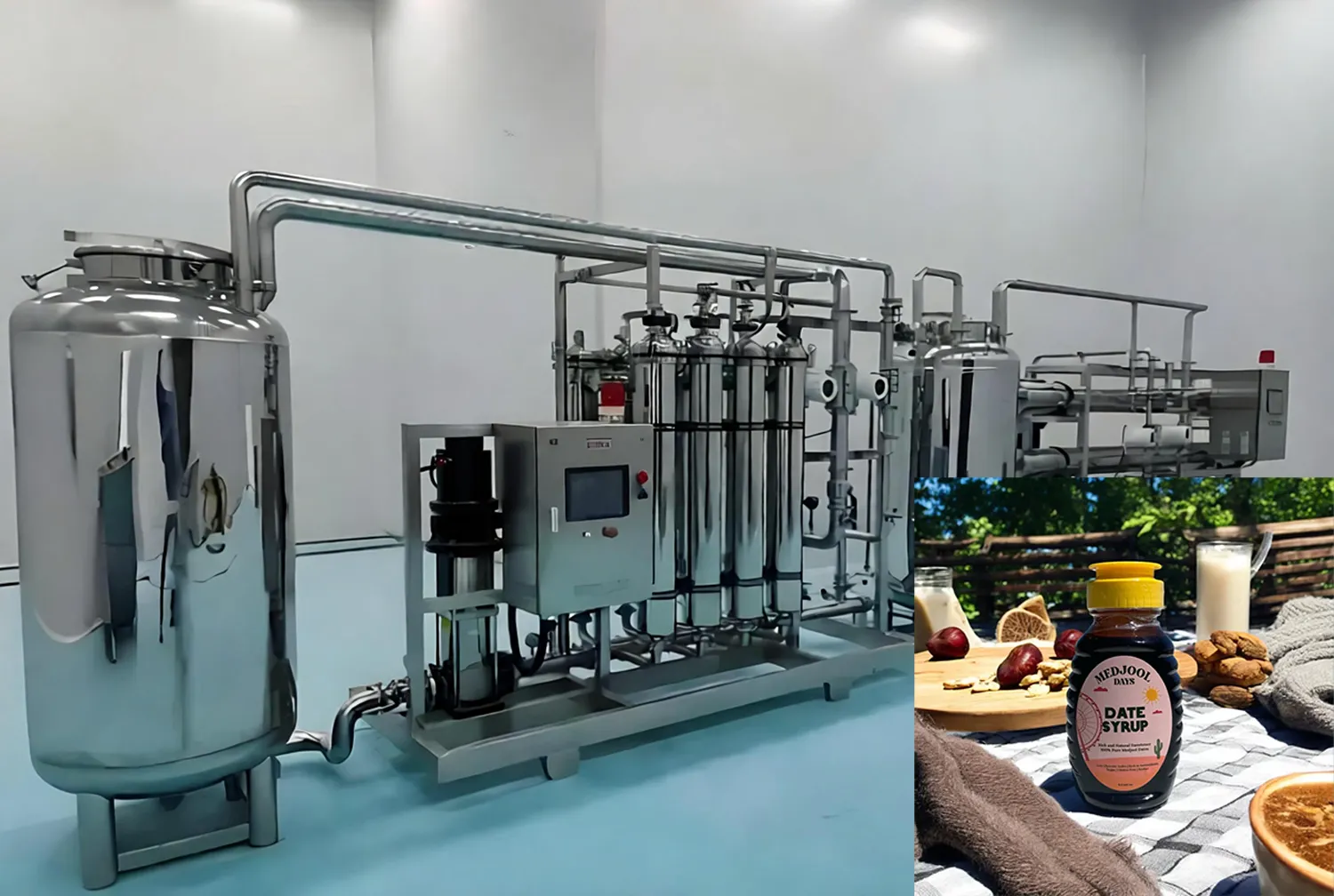
2. Why Membrane Technology Transforms Date Syrup Production
Membrane separation systems (ceramic microfiltration, ultrafiltration, nanofiltration) bring unique improvements to date syrup processing:
-
100% physical separation
No chemical additives, diatomite or harmful residues, meeting organic and clean‑label requirements.
-
Low‑temperature operation
Runs at 5–45°C to preserve natural aroma, color and nutrients, avoiding browning and caramelization.
-
Permanent clarity stability
Removes pectin, protein, colloids and macromolecular pigments to prevent re‑turbidity during storage.
-
Ultra‑high energy saving
Energy consumption is only about 30% of traditional thermal concentration, greatly reducing steam and utility costs.
-
High automation & continuity
Supports CIP cleaning, stable flux and long service life (2–3 years), lowering labor and maintenance cost.
-
Higher product yield
Improves sugar recovery rate and reduces material waste compared to filter press and centrifugation.
3. Complete Membrane‑Based Date Syrup Production Process
The industrial membrane process consists of six stable steps:
1 Raw Material Pretreatment
- Clean, sort and pit high‑quality dried dates.
- Hot water extraction: date‑to‑water ratio 1:3–1:4, 70–80°C, 30–60 minutes.
- Beat into uniform pulp for membrane separation.
2 Ceramic Membrane Coarse Filtration
- Function: Remove peel, fiber, sediment and large suspended particles.
- Protection: Protects downstream ultrafiltration and nanofiltration membranes.
- Effect: Clear crude sugar liquid, turbidity < 1 NTU.
3 Ultrafiltration (UF) Refining & Impurity Removal
- Function: Remove pectin, protein, tannins, macromolecular pigments and microorganisms.
- Retention: Retains sugars, flavor and nutritional components.
- Effect: High light transmittance, pure taste, no astringency, long‑term stability.
4 Nanofiltration (NF) Low‑Temperature Pre‑Concentration
- Function: Remove water at room temperature, pre‑concentrate to 35–45 °Brix.
- Advantage: Greatly reduces load and time of subsequent vacuum concentration.
- Energy saving: Cut total energy consumption by 60–70%.
5 Short‑Path Vacuum Concentration
- Mild low‑temperature concentration to final 70–75 °Brix.
- No burnt taste, no dark browning, natural amber color.
6 Sterilization and Filling
- Pasteurization or UHT sterilization.
- Hot filling into sterile bottles, sealed and cooled.
- Stable quality and long shelf life.
4. Key Membrane Equipment & Parameters for Date Syrup
| Equipment | Purpose | Temperature | Pressure |
|---|---|---|---|
| Ceramic Membrane System | Coarse filtration & clarification | < 50°C | 0.1–0.4 MPa |
| Ultrafiltration (UF) System | Refining & impurity removal | 5–45°C | ≤ 0.7 MPa |
| Nanofiltration (NF) System | Low‑temp pre‑concentration | 5–45°C | ≤ 2.0 MPa |
| Pilot Membrane Test System | Formula & parameter verification | 5–45°C | 0.1–2.0 MPa |
| CIP Cleaning System | Flux recovery & membrane protection | 20–50°C | — |
5. Membrane Process vs. Traditional Process: Full Comparison
| Indicator | Traditional Process | Membrane Separation Process |
|---|---|---|
| Clarity & Stability | Easy re‑turbidity, precipitation | Long‑term clear, no sediment |
| Color & Flavor | Browning, burnt taste | Natural amber, pure date aroma |
| Energy Consumption | High (steam‑dependent) | Low (≈30% of traditional) |
| Additives | Diatomite, flocculants | No additives |
| Automation Level | Low, labor‑intensive | High, continuous operation |
| Shelf Life | Relatively short | Significantly extended |
| Product Grade | Medium | High‑end, organic‑grade |
6. Benefits for Food Manufacturers
- Upgrade product quality to meet high‑end market and export standards.
- Reduce production cost through energy saving and yield improvement.
- Improve automation to lower labor intensity.
- Achieve clean‑label positioning to enhance brand competitiveness.
- Suitable for new production lines or retrofitting existing lines.
7. Frequently Asked Questions (FAQs)
1. Is membrane technology safe for food‑grade date syrup?
Yes. All materials are food‑grade, compliant with FDA and food safety standards. Physical separation without chemicals ensures safety.
2. How long do membrane elements last?
Normally 2–3 years with regular CIP cleaning and proper operation.
3. Can membrane equipment be retrofitted to existing production lines?
Yes. Ultrafiltration and nanofiltration systems can be added without changing the original pretreatment.
4. How much energy can be saved?
About 60–70% energy reduction compared to full thermal concentration.
5. What is the final sugar content of date syrup?
Stable at 70–75 °Brix with good fluidity and long shelf life.
8. Conclusion
Membrane separation equipment has become the core technology for modern high‑quality date syrup production. It upgrades clarification, refining and concentration stages, significantly improving clarity, flavor, color and shelf life while greatly reducing energy consumption and production costs.
With the global trend of natural sweeteners and clean‑label food, membrane technology will continue to lead the upgrading of the date syrup industry toward automation, high efficiency, low carbon and high‑end products.