Efficient Extraction of Functional Ingredients from Fruits and Vegetables: Principles, Applications, and Cutting-Edge Advances of Membrane Separation Technology
Fruits and vegetables are rich in various functional ingredients such as polyphenols, anthocyanins, dietary fiber, starch, and resveratrol. These ingredients possess multiple physiological activities including antioxidant, anti-inflammatory, and metabolic regulation effects, and are widely used in food, pharmaceutical, cosmetics, and other fields. Traditional extraction technologies, such as solvent extraction and hot pressing, have drawbacks including high energy consumption, significant component loss, solvent residues, and environmental pollution, making it difficult to meet the market demand for green production and high-quality products. As a new type of green separation technology, membrane separation achieves precise component separation based on the selective permeability of materials. With advantages of high efficiency, energy conservation, environmental friendliness, and normal-temperature operation, it has become a research focus in the field of functional ingredient extraction from fruits and vegetables, driving the industry towards low-carbon and refined upgrading.
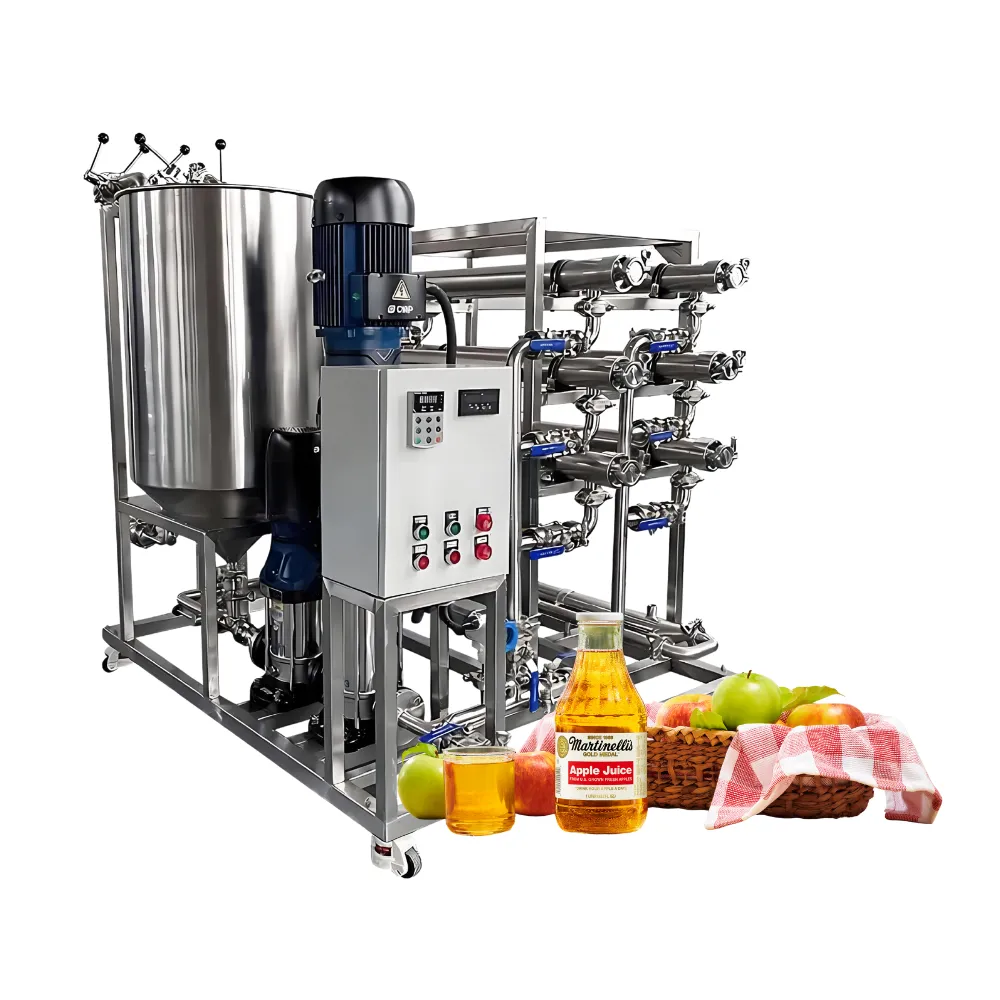
Common Membrane Separation Technologies and Their Principles for Extracting Functional Ingredients from Fruits and Vegetables
Membrane separation technology relies on membrane materials with specific pore sizes and chemical properties as the core, realizing mixture separation based on differences in molecular size, charge, solubility, and other characteristics. It does not require the addition of chemical reagents and can maximize the retention of the activity of functional ingredients in fruits and vegetables. Currently, the four most widely used membrane separation technologies in the extraction of functional ingredients from fruits and vegetables are microfiltration, ultrafiltration, nanofiltration, and reverse osmosis. In addition, technologies such as forward osmosis and electrodialysis have gradually achieved industrial application.
1. Microfiltration (MF): Core Pretreatment Technology
Microfiltration membranes have a pore size range of 0.1~10μm and operate at low pressure (0.1~0.5MPa). Their core function is to pretreat fruit and vegetable extracts, removing macromolecular impurities such as suspended particles, cell debris, colloids, and microorganisms, laying a foundation for subsequent refined separation. Based on the sieving mechanism, this technology can effectively clarify the extract while reducing the pollution risk of subsequent membrane modules. For example, treating carrot juice with a 0.45μm polypropylene microfiltration membrane can achieve a turbidity removal rate of over 98%, while the loss rate of functional ingredients such as soluble sugars and vitamins is less than 5%, balancing clarification effect and component retention.
2. Ultrafiltration (UF): Separation and Purification of Macromolecular Functional Ingredients
Ultrafiltration membranes have a pore size of 0.01~0.1μm and a molecular weight cut-off range of 1,000~1,000,000 Daltons, operating at 0.5~2.0MPa. They are suitable for the separation and purification of macromolecular functional ingredients such as proteins, polysaccharides, and starch in fruits and vegetables. Its separation mechanism combines sieving and adsorption, and the charge and van der Waals forces on the membrane surface can assist in achieving precise separation. For example, treating tomato juice with a 100kDa ultrafiltration membrane can effectively remove macromolecular pectin and proteins, reducing the juice viscosity by 40% while retaining more than 95% of β-carotene and extending the product shelf life to 28 days. In the extraction of loquat seed starch, ultrafiltration can assist in removing small-molecular impurities, improving starch purity and film-forming properties.
3. Nanofiltration (NF): Enrichment of Small-Molecular Active Ingredients
Nanofiltration membranes have a pore size of 1~10nm and a molecular weight cut-off of 300~1,000Da, operating at 3.0~10.0MPa. They excel in separating and enriching small-molecular active ingredients such as polyphenols, anthocyanins, and resveratrol in fruits and vegetables, while removing some inorganic salts and small-molecular impurities. Its separation mechanism is based on charge repulsion and solution-diffusion theory, with good selectivity for divalent ions and small-molecular organic compounds. For example, treating blueberry juice with a polyamide nanofiltration membrane with a molecular weight cut-off of 200Da can increase the anthocyanin concentration by more than 3 times and the salt removal rate by over 60%. In resveratrol extraction, nanofiltration can achieve efficient enrichment of active ingredients, while solving the problems of poor water solubility and easy decomposition, improving application stability.
4. Reverse Osmosis (RO): Deep Concentration and Dehydration
Reverse osmosis membranes have the smallest pore size (0.0001~0.001μm), which can almost completely retain all solutes and only allow water molecules to pass through, operating at 10.0~50.0MPa. They are mainly used for deep concentration and dehydration of fruit and vegetable functional ingredient extracts. Based on the solution-diffusion theory, this technology reduces energy consumption by 40%~60% compared with traditional thermal concentration, avoiding component degradation caused by high temperatures. For example, treating apple juice with reverse osmosis membranes can increase the soluble solid content to over 50%, the water removal rate to more than 95%, and the vitamin retention rate to 98%, greatly improving product added value.
Practical Applications of Membrane Separation Technology in Extracting Functional Ingredients from Fruits and Vegetables
With the optimization of membrane material performance and process upgrading, membrane separation technology has achieved large-scale extraction of various functional ingredients from fruits and vegetables, covering fruits, vegetables, and processing by-products. It not only improves extraction efficiency but also promotes resource recycling.
1. Application in Fruit Functional Ingredient Extraction
In the field of fruit processing, membrane separation technology is widely used for extracting functional ingredients from grapes, blueberries, loquats, mangoes, and other fruits. Research by the team led by Professor Wu Hejun from Sichuan Agricultural University shows that using ultrasonic-assisted enzymatic extraction combined with ultrafiltration and nanofiltration technology, starch extracted from loquat seeds is used as a film-forming matrix, and then membrane separation technology is used to assist in preparing resveratrol-loaded core-shell structured nanoparticles, successfully developing a high-performance antioxidant composite film. Among them, resveratrol shows good sustained-release performance in high-fat food simulant, significantly improving the preservation effect of oil-based food. In grape processing, membrane separation technology can extract anthocyanins and polyphenols from grape pomace with an extraction rate of over 92%. Compared with traditional solvent extraction, it reduces energy consumption by 30%, has no solvent residues, and the product purity meets food-grade standards.
2. Application in Vegetable Functional Ingredient Extraction
In vegetable processing, membrane separation technology can achieve efficient extraction and purification of functional ingredients from carrots, spinach, tomatoes, bean sprouts, and other vegetables. For example, using a combination of microfiltration and ultrafiltration to treat carrot juice can simultaneously achieve clarification and separation/purification of β-carotene with a retention rate of over 95%. Using ultrafiltration membranes to treat soymilk can achieve a soybean protein recovery rate of over 90% and a whey protein removal rate of over 85%, improving the quality of protein products. In addition, forward osmosis technology performs outstandingly in cucumber juice concentration, reducing energy consumption by 70% and increasing sugar retention rate by 25% compared with traditional thermal concentration, which is in line with the concept of green production.
3. Resource Utilization of Fruit and Vegetable Processing By-Products
By-products such as peels, seeds, and vegetable residues generated during fruit and vegetable processing are rich in various functional ingredients but have long been discarded, causing resource waste and environmental pollution. Membrane separation technology provides an effective path for the resource utilization of these by-products. For example, when extracting starch from jackfruit seeds and longan seeds, the combination of microfiltration and ultrafiltration is used to remove impurities and improve starch purity. When extracting pectin from citrus peels, ultrafiltration purification and nanofiltration enrichment are adopted to obtain high-quality pectin products with a recovery rate increased to over 85%. At the same time, membrane separation technology can treat fruit and vegetable processing wastewater, achieving a water reuse rate of over 80% and a soluble sugar recovery rate of 85%, forming a "separation-reuse" circular economy model.
Advantages and Current Challenges of Membrane Separation Technology for Fruits and Vegetables
Core Advantages
Compared with traditional extraction technologies, membrane separation technology has significant advantages in extracting functional ingredients from fruits and vegetables: first, it is green and environmentally friendly, requiring no addition of chemical solvents, no secondary pollution, and meeting the safety requirements of food processing and the trend of low-carbon development; second, it operates at normal temperature, avoiding the damage of high temperatures to heat-sensitive ingredients such as polyphenols and anthocyanins, and maximizing the retention of their physiological activity; third, it is efficient and precise, enabling precise separation of components with different molecular weights and improving product purity and quality; fourth, it saves energy and reduces consumption, with a modular design that allows continuous operation, and energy consumption is significantly lower than that of traditional distillation and thermal concentration, with some processes reducing energy consumption by over 70%; fifth, it has wide adaptability, and can flexibly combine multiple membrane separation technologies according to different fruit and vegetable components and extraction needs, balancing large-scale production and refined processing.
Current Challenges
Despite its broad application prospects, membrane separation technology still faces some bottlenecks in industrial promotion: first, membrane fouling is prominent. Fruit and vegetable extracts have complex components, and macromolecular substances are prone to adsorption and deposition on the membrane surface, leading to decreased membrane flux, shortened operation cycle, and increased cleaning costs and energy consumption. Cross-flow filtration technology can reduce the fouling rate to a certain extent but cannot completely solve the problem; second, the cost of membrane materials is high. The preparation process of high-performance composite membranes and intelligent membranes is complex, and the initial equipment investment is about 500,000 to 800,000 yuan per ton, limiting the application of small and medium-sized enterprises; third, large-scale application technology is immature. The process parameters of some new membrane separation technologies (such as forward osmosis) still need optimization, making it difficult to meet the efficiency requirements of large-scale production; fourth, membrane performance needs to be improved. Some membrane materials have insufficient pollution resistance and stability, and are prone to damage and degradation during long-term operation.
Latest Development Trends of Membrane Separation Technology for Fruits and Vegetables
With the integration and development of materials science, artificial intelligence, and other technologies, membrane separation technology for extracting functional ingredients from fruits and vegetables is breaking through towards high performance, intelligence, low cost, and resource utilization, showing three major development trends.
1. R&D and Iteration of New Membrane Materials
The performance of membrane materials directly determines the separation effect, and new composite membranes have become the research focus. Nanocomposite membranes such as graphene oxide-modified polyamide membranes and carbon nanotube/chitosan composite membranes have both high strength and high selectivity. In the denitrification treatment of spinach juice, their flux is 40% higher than that of traditional membranes, and the TOC removal rate exceeds 98%. Hydrophobic membranes (such as polyvinylidene fluoride PVDF) achieve an oil-water separation efficiency of 90% in the degumming process of rapeseed oil, with a stable membrane flux of 50 LMH (liters per square meter per hour). In addition, the development of renewable biomass-based membrane materials (such as loquat seed starch membranes and pectin membranes) has realized the greenization and degradability of membrane materials, conforming to the concept of circular economy.
2. Technology Combination and Intelligent Upgrading
The limitations of single membrane separation technology have gradually become apparent, and the combination of multiple technologies has become the mainstream trend. The combination of membrane separation technology with ultrasound, microwave, enzymatic hydrolysis, and other technologies can greatly improve extraction efficiency. For example, ultrasonic-assisted membrane separation can destroy the cell structure of fruits and vegetables, promote the release of functional ingredients, and increase the extraction rate by 20%~30%. The combination of membrane separation and freeze-drying can achieve efficient concentration and drying of functional ingredients, retaining active components. At the same time, artificial intelligence is deeply integrated with membrane separation technology. By using machine learning to analyze parameters such as flow rate and pressure difference, a membrane fouling prediction model is constructed, which can extend the fouling interval to 200 hours, achieving an energy-saving effect of 15% in industrial applications. pH/ion-responsive intelligent membranes can adapt to changes in fruit and vegetable juice components, and the separation selectivity is automatically adjusted with fluctuations in ion strength, with a rejection rate error controlled within ±5%.
3. Breakthroughs in Low-Cost and Large-Scale Application
To address the high cost of membrane materials and insufficient large-scale application, researchers are reducing the cost of membrane materials and equipment by optimizing preparation processes and using low-cost raw materials. The upgraded design of modular membrane modules can flexibly adjust the processing scale to meet the production needs of small and medium-sized enterprises. In addition, renewable energy-driven membrane systems (such as solar photovoltaic membranes) have gradually been put into use. In remote fruit and vegetable processing plants, photovoltaic-powered reverse osmosis systems reduce operating costs by 60% with an annual processing capacity of 100 tons per day. The technology of 3D printing customized membrane pore structures is becoming mature, and it is expected to realize on-demand preparation of highly adaptable separation modules by 2030, further promoting the industrial popularization of membrane separation technology.
Conclusion
As a green and efficient separation method, membrane separation technology has completely changed the traditional mode of extracting functional ingredients from fruits and vegetables. It not only improves product quality and extraction efficiency but also promotes the resource utilization of fruit and vegetable processing by-products, conforming to the development trend of low-carbon, high-quality, and sustainable food industry. With the R&D of new membrane materials, process optimization, and the integration of intelligent technologies, membrane separation technology will gradually break through existing bottlenecks, reduce application costs, expand application scenarios, and play a more important role in the deep processing of fruits and vegetables. In the future, it is necessary to continuously strengthen the research on core technologies such as membrane fouling control and low-cost membrane material preparation, promote the in-depth integration of membrane separation technology with the fruit and vegetable processing industry, and help the high-quality development of the industry.