Membrane Separation Equipment: The Core Technology for WPC80 Production Lines
In the global sports nutrition, functional food and infant formula industries, WPC80 (Whey Protein Concentrate 80%) is one of the most popular high-value dairy ingredients. With a protein content of around 80%, balanced lactose and fat content, excellent solubility and biological activity, WPC80 is widely used in protein supplements, health drinks, senior nutrition powder and special medical foods.
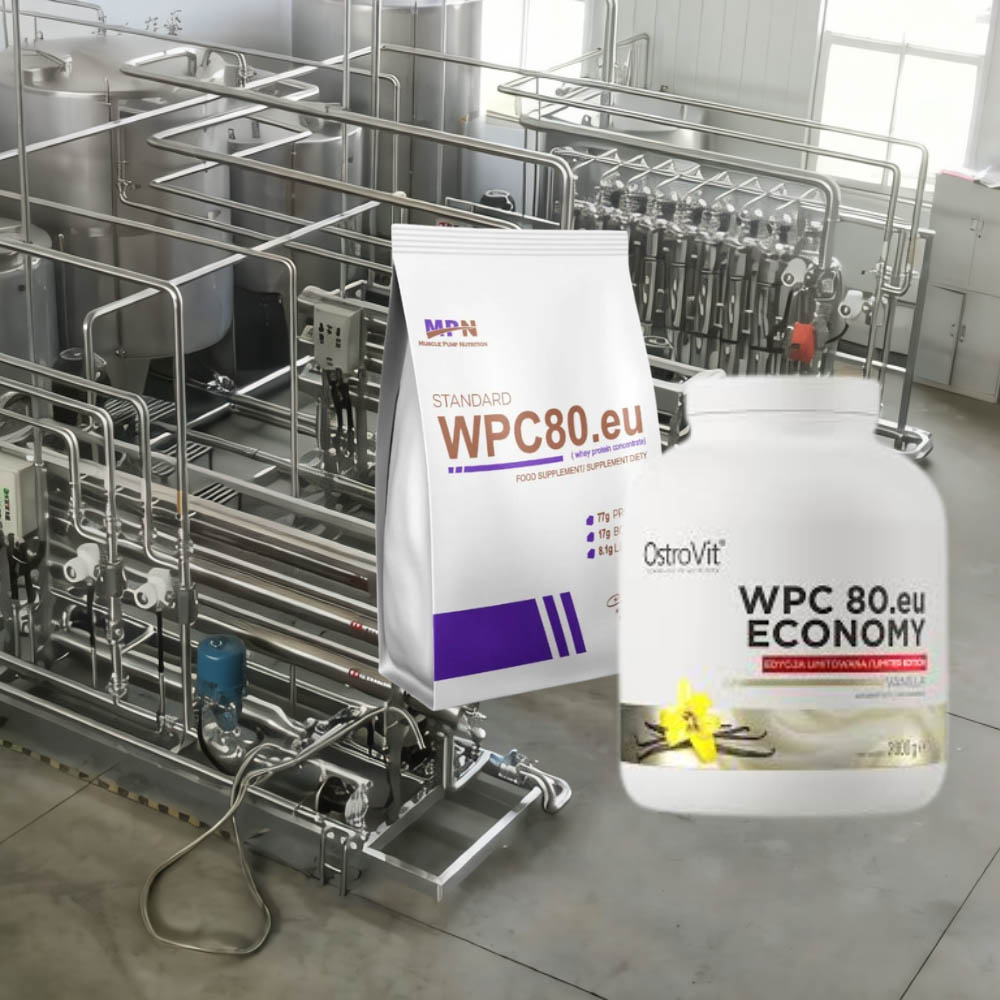
As market demand keeps growing worldwide, manufacturers are pursuing higher product quality, lower production costs and greener manufacturing processes. Traditional high-temperature evaporation methods can no longer meet modern production standards due to severe protein denaturation, high energy consumption and unstable product quality. Today, membrane separation technology has become the standard core process for modern WPC80 production lines across the globe.
This article comprehensively introduces the working principle, complete process, key advantages, equipment selection and troubleshooting of membrane separation systems applied in WPC80 production lines, providing professional references for dairy processors, food factories and project investors.
1. Market Demand & Drawbacks of Traditional WPC80 Production
1.1 Growing Global Demand for WPC80
Driven by the health consumption trend, the global WPC80 market maintains steady growth. End customers now set stricter requirements on protein activity, purity, taste and shelf life. High-quality WPC80 with low denaturation rate and high nutrient retention enjoys stronger market competitiveness and higher profit margins.
1.2 Disadvantages of Conventional Production Processes
Traditional WPC80 production relies on high-temperature concentration and evaporation, which brings multiple problems:
- Severe protein denaturation: Long exposure to high temperature destroys active substances such as immunoglobulins and alpha-lactalbumin, leading to a low NSI (Non-Soluble Index) below 85%.
- High energy cost: Thermal evaporation consumes massive power, accounting for 40% to 50% of total production cost.
- Poor separation effect: It is difficult to separate lactose, fat and minerals precisely, resulting in unstable product indicators and poor solubility.
- Chemical additives required: Extra reagents are needed for auxiliary separation, which raises food safety risks and wastewater treatment pressure.
1.3 Membrane Separation: An Innovative Solution
Membrane separation is a physical separation technology driven by pressure. According to molecular size difference, selective membranes intercept target substances while allowing small molecules to pass through. The whole process runs at low temperature without chemical additives. It perfectly solves all pain points of traditional processes and has become the mainstream choice for large-scale WPC80 production.
2. Complete Process Flow of Membrane Separation for WPC80 Production
A standard WPC80 production line adopts a combined membrane system: Microfiltration (MF) → Ultrafiltration (UF) → Optional Nanofiltration (NF). The whole production runs in closed pipelines under low temperature, connecting seamlessly with vacuum concentration and spray drying sections.
2.1 Pre-treatment & Microfiltration (MF)
Raw material is liquid whey, a by-product from cheese and casein production. Original whey contains 0.6%~0.8% protein, 4.5%~5.2% lactose and a small amount of fat and bacteria.
Before membrane separation, raw whey goes through pasteurization (72℃, 15s) and disc centrifugation to remove free fat, with a defatting rate over 95%. Then the liquid enters the microfiltration unit.
- Membrane specification: 0.1~0.4 μm PVDF microfiltration membrane
- Operating parameters: Temperature 20~25℃, transmembrane pressure 0.2~0.3 MPa
- Function: Remove residual fat globules, bacteria and coarse colloids to obtain clear and sterile whey liquid, and protect subsequent ultrafiltration membranes from contamination and blockage.
2.2 Core Section: Ultrafiltration (UF) for Protein Concentration
Ultrafiltration is the key unit that determines WPC80 final purity. It uses molecular sieving effect to concentrate whey protein efficiently.
- Membrane selection: 10~20 kDa PES ultrafiltration membrane
- Operating parameters: Temperature 20~28℃, transmembrane pressure 0.3~0.4 MPa
- Working principle: Whey protein macromolecules are intercepted by the membrane, while water, lactose and mineral ions pass through the membrane as permeate.
- Production result: Protein concentration rises from less than 1% to 18%~22%. The protein recovery rate reaches above 98%, and lactose content is controlled within 4%~10%, fully meeting the basic standard of WPC80.
Cross-flow filtration design is adopted to reduce membrane fouling. Equipped with automatic CIP cleaning system, the service life of ultrafiltration membranes can reach 5 to 8 years.
2.3 Optional Nanofiltration (NF) for Deep Refining
For high-end low-lactose and low-ash WPC80 products applied in infant food and premium supplements, a nanofiltration unit can be added after ultrafiltration. Nanofiltration further removes residual lactose and monovalent salts, lowering lactose content below 4% and ash content below 3%.
2.4 Follow-up Processes: Vacuum Concentration & Spray Drying
The concentrated liquid from membrane separation is delivered to low-temperature vacuum evaporator (38~42℃) to increase solid content to 30%~35%. Afterwards, the liquid is sent to spray dryer. With strict temperature control, the material core temperature is kept below 75℃ to avoid protein denaturation. Finally, finished WPC80 powder with moisture ≤5.0% is obtained.
3. Core Advantages of Membrane Separation for WPC80 Lines
3.1 Maximize Protein Biological Activity
The entire membrane system operates under low temperature (20~40℃). No thermal damage occurs to active proteins. The NSI of final WPC80 is higher than 95%, and the retention rate of IgG exceeds 93%. Active ingredients such as lactoferrin are well preserved, greatly improving product nutritional value.
3.2 Stable Purity & Consistent Product Quality
Membrane separation realizes precise molecular-level separation. Finished WPC80 stably reaches the standard: protein 80%±2%, fat 2%~6%, lactose 4%~10%. Batch difference is controlled within 1%. The equipment can also be adjusted flexibly to produce WPC35, WPC70 and WPI90, realizing multi-product flexible production.
3.3 Significant Energy Saving & Cost Reduction
Compared with traditional high-temperature evaporation, membrane separation reduces total energy consumption by 70%~80%. The fully automatic PLC control system cuts labor cost and improves production efficiency by 30%~50%. No chemical additives are used, so auxiliary material cost and wastewater treatment cost are reduced simultaneously.
3.4 Environmentally Friendly & Resource Reuse
This is a purely physical separation process with no chemical residues. The permeate rich in lactose and minerals can be recycled to produce lactose powder and whey drinks. Fat separated by centrifuge can be processed into cream. It realizes 100% high-value utilization of whey by-products. All pipelines and units are equipped with closed CIP cleaning system, complying with global environmental protection regulations.
3.5 Excellent Powder Performance & Longer Shelf Life
WPC80 produced by membrane technology features good fluidity, instant solubility and no agglomeration. Microbial indicators fully comply with international food standards. The shelf life of pure WPC80 powder can reach 24 months.
4. Key Points for Membrane Equipment Selection
4.1 Membrane Material
- Microfiltration membrane: PVDF (Polyvinylidene Fluoride) is the first choice, with excellent acid and alkali resistance, anti-fouling performance and high temperature resistance for sterilization.
- Ultrafiltration membrane: PES (Polyethersulfone) is recommended, featuring high hydrophilicity, stable flux and strong selectivity for whey protein.
- Ordinary PP or PE membranes are not suitable for whey processing due to easy fouling and short service life.
4.2 Membrane Module Type
- Spiral wound membrane: Compact structure, easy installation and maintenance, suitable for medium and small production lines with daily capacity below 200 tons.
- Tubular membrane: Strong anti-fouling ability, ideal for high-viscosity raw whey and large-scale production lines over 200 tons per day.
4.3 Standard Operating Parameters
- Ultrafiltration molecular weight cut-off: 10~20 kDa
- Operating temperature: 20~28℃
- Transmembrane pressure: MF 0.2~0.3 MPa; UF 0.3~0.4 MPa
4.4 Complete System Configuration
A qualified WPC80 membrane production line must include pre-treatment unit, MF+UF membrane unit, CIP online cleaning unit, PLC automatic control unit and real-time monitoring unit for pressure, temperature and concentration. For high-end products, nanofiltration unit and data traceability system are optional.
5. Common Problems & Practical Solutions
5.1 Decline of Membrane Flux & Insufficient Production Capacity
Causes: Membrane fouling by protein colloid, incomplete pre-treatment, irregular CIP cleaning.
Solutions: Optimize pre-treatment process; Perform standard CIP cleaning with alkaline solution and acid solution regularly; Carry out chemical regeneration for contaminated membranes periodically.
5.2 Protein Content Lower Than 80%
Causes: Improper ultrafiltration membrane selection, insufficient operating pressure, insufficient diafiltration times.
Solutions: Replace with standard 10~20 kDa PES membrane; Adjust transmembrane pressure to 0.35 MPa; Increase diafiltration times to enhance lactose removal.
5.3 Poor Solubility & Powder Agglomeration
Causes: Excessively high drying temperature, excessive residual lactose, high humidity in packaging workshop.
Solutions: Control outlet air temperature of spray dryer below 85℃; Optimize ultrafiltration process to reduce lactose content; Keep relative humidity of packaging room below 60% and adopt nitrogen-filled sealing packaging.
6. Summary & Industry Outlook
Membrane separation equipment has become the irreplaceable core of modern WPC80 production lines. Its advantages of low-temperature separation, high activity retention, energy saving and environmental protection help dairy manufacturers create high-quality, cost-effective and competitive WPC80 products.
With the continuous upgrading of membrane materials and intelligent control systems, WPC80 production will develop towards higher activity, lower lactose and full automatic operation. For investors and manufacturers planning to build or upgrade WPC80 production lines, reasonable membrane selection, standardized parameter setting and complete daily maintenance system are the keys to stable and profitable long-term production.