Membrane separation technology is driving the milk industry towards a future of high efficiency and high quality
Membrane separation technology has become a fundamental "intelligent sieve" in the dairy industry, significantly enhancing milk quality and production efficiency. This innovative method allows for precise separation and concentration of milk components through advanced filtration processes, operating at low temperatures and pressures to preserve the natural flavor and nutritional value of milk .
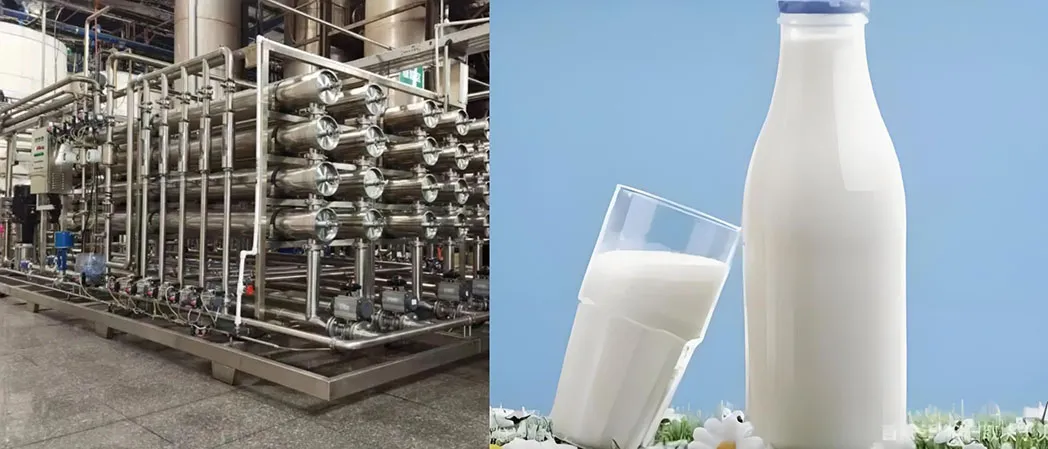
Basic Principles and Classification of Membrane Separation Technology
Membrane separation technology functions as a molecular-level filtration system. It utilizes semi-permeable membranes to separate particles based on size and molecular weight. The technology is categorized into four main types based on pore size and separation precision :
- Microfiltration (MF) with pore sizes of 0.1-1.0 micrometers, primarily used for removing bacteria, fat globules, and suspended solids .
- Ultrafiltration (UF) with pore sizes of 0.001-0.1 micrometers (or a molecular weight cut-off of 1,000-300,000 Dalton), effectively retaining proteins and colloids while allowing water, lactose, and salts to pass through .
- Nanofiltration (NF) with pore sizes of approximately 0.001 micrometers (1-2 nm), capable of removing specific ions and smaller organic molecules, often used for partial demineralization and concentration .
- Reverse Osmosis (RO) with the smallest pores, effectively retaining all solutes including ions, and used primarily for water removal and concentration .
These processes operate on a purely physical principle, requiring no chemical additives or phase changes, which makes them energy-efficient and environmentally friendly .
Milk Concentration and Component Standardization
Membrane technologies, especially Reverse Osmosis (RO) and Ultrafiltration (UF), play a crucial role in concentrating milk and standardizing its components .
- Reverse Osmosis Concentration: RO can remove over 60% of water, increasing the solid content of milk from about 8% to 22%, with a solid loss rate of only 0.15%-0.2% . This is particularly valuable for reducing transportation costs, as milk can be concentrated near production sites .
- Ultrafiltration Concentration: UF is typically conducted at 30-50°C, concentrating skim milk solids by 3-4 times. Through diafiltration (a process that involves dilution and re-filtration), lactose and salts can be removed, resulting in a skim milk concentrate with protein content as high as 80% . This method standardizes the total solid content of milk, which can fluctuate seasonally, ensuring consistent product quality .
Whey Desalting and Protein Concentration
Whey, a by-product of cheese production, contains valuable proteins. Membrane technology transforms whey from animal feed into high-value products.
- Protein Concentration: Ultrafiltration separates low-molecular-weight components like water, salts, and lactose from whey, improving the ratio of protein to lactose and salts. Whey can be concentrated to over 25% total solids, and after spray drying, the resulting whey protein concentrate powder can have a protein content of 35-80%.
- Desalting: Nanofiltration (NF) is effective for desalting whey. For salty whey from hard cheese production, which has extremely high salt content, NF provides a cost-effective method for partial desalination before further processing . The "diafiltration" process with UF membranes can also effectively remove lactose and ash while concentrating proteins, producing high-protein skim milk powder and desalted, delactosed whey powder used in products like ice cream and yogurt.
Microfiltration for Bacterial Removal and Component Separation
- Bacterial Removal: Using MF membranes with a pore size of 1.4 micrometers can completely retain bacteria and fat globules while allowing casein to pass through. Combining MF with high-temperature short-time (HTST) pasteurization reduces the thermal treatment intensity and improves the quality of sterile milk, with bacterial removal rates exceeding 99.9% . This combination can produce Extended Shelf Life (ESL) milk with a shelf life of up to about 20 days without strong heat treatment.
- Component Separation: MF is also used for fractionating milk components, such as separating casein from whey proteins based on their size differences . A growing trend involves combining membrane filtration with chromatography to extract high-value components like lactoferrin.
Application in Cheese Production
The application of Ultrafiltration in cheese production significantly enhances yield and quality .
- Traditional Process Issues: In conventional cheese making, about 25% of whey proteins are lost in the whey drained from the curd .
- UF Advantage: Using UF to concentrate skim milk before cheese making removes most lactose and retains whey proteins in the concentrate. This integration of whey proteins into the cheese not only increases yield but also improves quality . Research shows that cheese and sweet yogurt made from RO-concentrated milk are satisfactory, and the UF method is more cost-effective than vacuum evaporation in terms of equipment investment and operating costs .
Technical Economic Benefits and Energy Efficiency
Membrane separation technology offers significant economic and energy-saving advantages .
- Energy Efficiency: Operating at low temperatures and pressures without phase changes makes membrane processes highly energy-efficient. The energy consumption is only about one-third to one-eighth of that required for thermal evaporation or freezing concentration .
- Economic Benefits: A case study from a Cuban cheese company demonstrated that combining Reverse Osmosis and evaporation for whey processing could save $80,000 annually compared to using evaporation alone . The technology also boasts a small equipment footprint, simple structure, low investment costs, and easy operation .
Application Prospects and Challenges
While membrane separation technology is mature and widely used in the dairy industry in developed countries, its application in some regions, like China, still has room for growth . The future points towards deeper processing and wider adoption.
The main challenge is membrane fouling, which leads to reduced flux and requires cleaning, affecting reuse and efficiency . Future developments will focus on solving membrane fouling, reducing production costs, and developing more efficient membrane materials .
Furthermore, regulations in some regions (e.g., EU countries not permitting standardization of total milk solids) may limit certain applications .
The dairy market is being reshaped by membrane separation technology. With growing consumer demand for high-protein, low-lactose milk, ultrafiltered milk can contain up to 6g of protein per 100ml, significantly higher than the 2.9-3.6g found in regular milk . As an efficient and energy-saving "intelligent sieve," this technology continues to expand into areas like amino acids, fruit juices, and biopharmaceuticals, creating new possibilities for the food industry .